Categories
Tips & Tricks

Using Standardized Caregiver Onboarding Checklists

Bringing on a new caregiver is more than just filling a position—it’s a critical moment that directly impacts your agency’s compliance, client safety, and overall quality of care.

Without a structured onboarding process, important steps can be missed. Documentation gets delayed. Training becomes inconsistent. And small gaps can quickly turn into major compliance risks.

That’s why creating a standardized caregiver onboarding checklist is one of the most effective ways to protect your agency and set your team up for success.


What Is a Caregiver Onboarding Checklist?

A caregiver onboarding checklist is a step-by-step process that ensures every new hire completes all required:

  • Documentation
  • Training
  • Credential verification
  • Compliance steps

Before they begin working with clients.

Instead of relying on memory or scattered processes, a checklist creates a repeatable, accountable system.


Why Standardization Matters

When onboarding is inconsistent, agencies often run into:

  • Missing or incomplete employee files
  • Expired or unverified credentials
  • Caregivers starting shifts before being fully cleared
  • Increased audit risk
  • Variability in care quality

Standardization eliminates these gaps.

Every caregiver goes through the same process, every time, ensuring nothing is overlooked.


Key Components of an Effective Onboarding Checklist

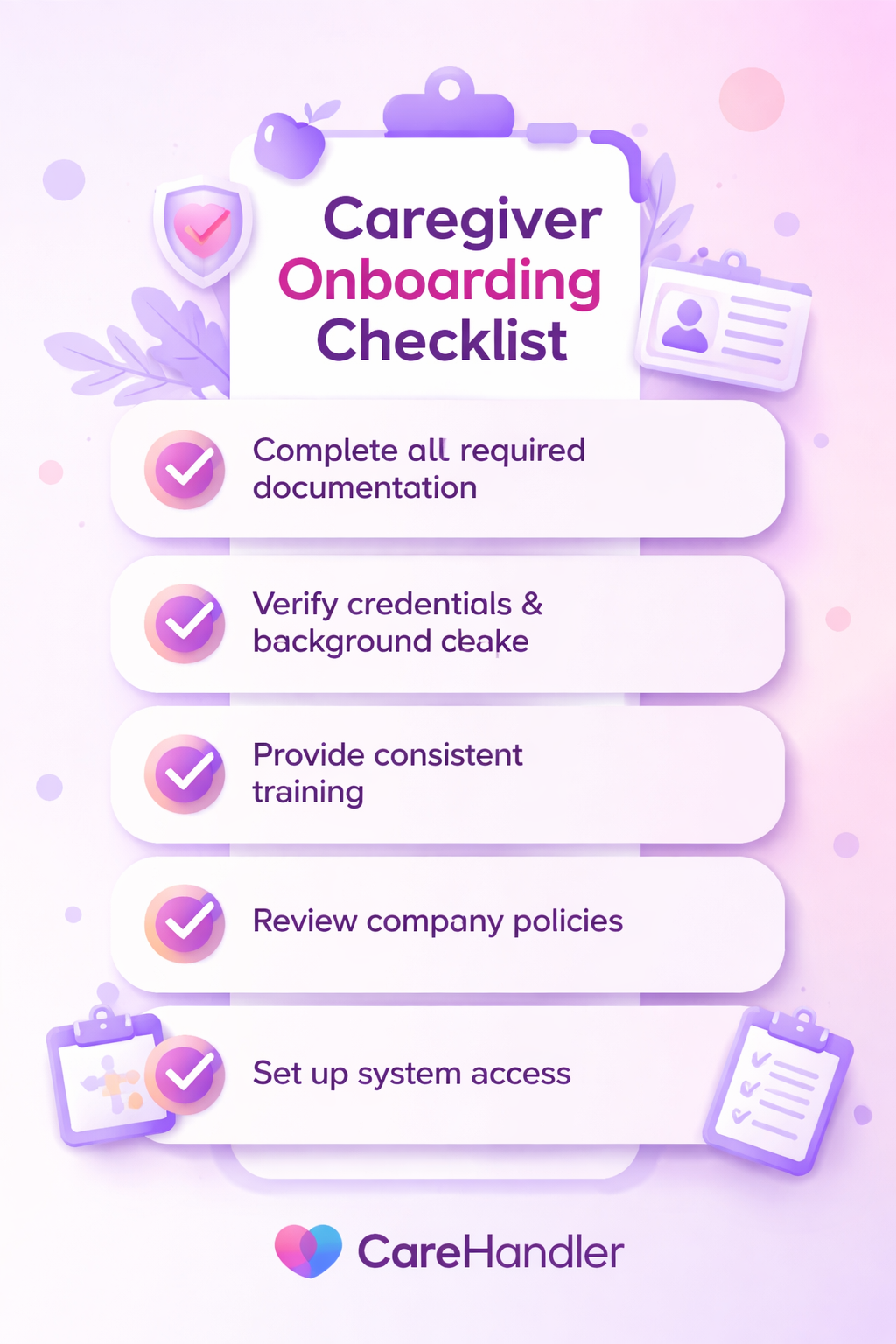
A strong onboarding checklist should cover four core areas:

1. Employment Documentation

Ensure all required paperwork is completed and stored properly:

  • I-9 verification
  • W-4 and state tax forms
  • Direct deposit setup
  • Signed policies and procedures

2. Credential Verification

Before a caregiver is scheduled, confirm:

  • Licenses or certifications (if required)
  • Background checks
  • TB tests or health screenings
  • Any state-specific compliance requirements

3. Training and Orientation

Every caregiver should receive consistent training, including:

  • Agency policies and expectations
  • EVV and documentation requirements
  • Client care standards
  • Safety protocols

4. System Access and Readiness

Before their first shift, ensure caregivers:

  • Have access to your systems
  • Understand how to clock in/out
  • Know how to complete visit notes
  • Can communicate with your administrative team

How This Impacts Compliance

From an audit perspective, onboarding is one of the first places reviewers look.

Incomplete files or missing documentation can lead to:

  • Compliance violations
  • Payment recoupments
  • Increased scrutiny from payers

A standardized checklist creates a clear paper trail, showing that:

  • Every caregiver was properly vetted
  • Required documentation was completed
  • Training was consistently delivered

This makes your agency audit-ready by design, not by last-minute preparation.


How This Improves Quality of Care

Beyond compliance, onboarding directly affects the care your clients receive.

When caregivers are:

  • Properly trained
  • Clear on expectations
  • Confident using your systems

They are far more likely to:

  • Deliver consistent, high-quality care
  • Complete accurate documentation
  • Communicate effectively with your team

Consistency at the start leads to consistency in the field.


Building Accountability Into Your Process

A checklist doesn’t just organize tasks—it creates accountability.

To make it effective:

  • Assign ownership for each step
  • Require sign-offs before moving forward
  • Prevent scheduling until onboarding is complete

This ensures that compliance is not optional—it’s built into your workflow.


How Carehandler Supports Structured Onboarding

At Carehandler, we believe that strong operations start with strong systems.

By connecting caregiver onboarding with scheduling, documentation, and billing workflows, agencies can:

  • Ensure caregivers are fully cleared before working
  • Maintain complete and accessible records
  • Reduce administrative errors
  • Strengthen compliance across the board

When onboarding is standardized, everything that follows becomes more consistent.


Final Thoughts

A caregiver onboarding checklist may seem simple, but its impact is significant.

It protects your agency.
It supports your caregivers.
And it ensures your clients receive the level of care they deserve.

Because in homecare, consistency isn’t just operational—it’s essential.

Categories
Tips & Tricks

A Simple Habit That Protects Your Home Care Agency

In the fast-paced world of home care, it’s easy for documentation to slip down the priority list—especially after a long shift. But one small habit can make a significant difference in your agency’s compliance, efficiency, and overall quality of care: encouraging caregivers to complete visit notes immediately after each shift.

The Risk of Delayed Documentation

Delayed documentation is one of the most common issues agencies face during audits and compliance reviews. When notes are completed hours—or even days—after a visit, important details can be forgotten, timelines become unclear, and inconsistencies may arise. Even if the care provided was excellent, poor documentation can create the appearance of gaps in service or non-compliance.

Auditors and regulators aren’t just reviewing care—they’re reviewing proof of care. If it’s not documented properly and promptly, it can raise red flags that put your agency at risk.

Why Immediate Documentation Matters

Encouraging caregivers to document right after their shift helps ensure:

  • Accuracy: Details are fresh, reducing the chance of errors or omissions.
  • Consistency: Notes reflect a clear, real-time record of care provided.
  • Accountability: Caregivers develop a reliable routine that supports compliance.

Timely documentation doesn’t just check a box—it tells the full story of the care your team delivers.

Protecting Your Agency, Caregivers, and Clients

Consistent documentation acts as a safeguard for everyone involved:

  • Your agency is protected during audits and compliance reviews.
  • Your caregivers have a clear record that supports their work and professionalism.
  • Your clients benefit from continuity of care, as accurate notes inform future visits and care plans.

In many cases, documentation can be the deciding factor in disputes, billing questions, or regulatory concerns. Having clear, timely notes ensures you’re always prepared.

Building Better Habits Across Your Team

The good news? This is a fixable issue. Small administrative habits can prevent major compliance problems. Consider:

  • Setting clear expectations for when notes must be completed
  • Using mobile-friendly documentation tools to make it easier in the field
  • Reinforcing the importance of timely notes during training and team meetings
  • Monitoring completion times and addressing delays early

When immediate documentation becomes part of your agency’s culture, it stops feeling like a burden and starts becoming second nature.


In home care, the smallest habits often have the biggest impact. Encouraging caregivers to complete visit notes right after each shift is a simple, practical step that strengthens compliance, improves care quality, and protects your entire operation.

Because at the end of the day, great care deserves to be clearly—and promptly—documented.

Categories
Audit Ready

How Approval Workflows Protect Agencies During Audits and Appeals

In homecare, adjustments happen.

Rates change.
Write-offs are issued.
Units are corrected.
Claims are resubmitted.

The problem isn’t that changes occur.

The problem is when those changes live in someone’s memory, a sticky note, or buried inside an email thread.

Because when an audit or appeal happens, memory isn’t documentation.

And inboxes aren’t internal controls.

The Risk of Informal Corrections

Many agencies still handle financial and billing adjustments informally:

  • A rate is adjusted after a quick verbal discussion.

  • A write-off is approved over email.

  • A unit correction is made “just this once.”

  • A rebill happens without a documented approval trail.

It feels efficient in the moment. But during an audit, those informal processes create real exposure.Auditors don’t ask: “Did you talk about this?”

They ask:

  • Who approved this change?

  • When was it approved?

  • What was the original value?

  • Why was it changed?

  • Where is the documentation?

If the answer is, “It was discussed,” you have a compliance gap.

Why Approval Workflows Matter

Approval workflows move agencies from informal communication to structured accountability.

Instead of relying on conversations, approval workflows require:

✔ A documented reason for the change
✔ A designated approver
✔ A time-stamped record
✔ A locked audit trail
✔ Visibility before billing or finalization

That structure does more than protect compliance.

It protects leadership.

How Approval Workflows Protect Revenue

Every rate change, write-off, or correction impacts financial reporting.

Without oversight, agencies risk:

  • Unapproved write-offs reducing revenue

  • Incorrect rate changes affecting billing accuracy

  • Duplicate or inconsistent claim corrections

  • Financial discrepancies between billing and accounting

Approval workflows ensure that every adjustment is intentional and reviewed.

This prevents silent revenue leakage and reduces costly errors that show up months later.

How Approval Workflows Strengthen Appeals

Appeals are won with documentation.

When payers deny or recoup funds, agencies must demonstrate:

  • That services were delivered as authorized

  • That documentation supports billing

  • That corrections were handled appropriately

  • That internal controls exist

A documented approval workflow shows the agency had structured oversight at the time of the change.That level of internal control carries weight.It demonstrates that the correction wasn’t reactive or careless — it was reviewed and approved within policy.

Automation Makes It Sustainable

Approval workflows should not require chasing emails or forwarding messages.

Your system should:

  • Require approval before rate changes apply

  • Flag write-offs for review

  • Lock finalized visits from editing  
  • Track who approved what and when

  • Connect adjustments directly to claims and reconciliation

In homecare, every adjustment tells a story. Approval workflows ensure it’s one you can defend.

Categories
Idaho Medicaid

UHC Idaho MMCP Update: Faster Claims Processing Starting April 6

UnitedHealthcare Idaho updates MMCP claims processing starting April 6, 2026. Learn how bypassing Medicare speeds up Medicaid reimbursement for HCBS providers.


There’s a meaningful update coming from UnitedHealthcare Community Plan of Idaho that is expected to improve HCBS claims processing—and more importantly, how quickly agencies get paid.

For agencies managing billing across multiple systems, this change represents a step toward more streamlined workflows, reduced administrative burden, and faster reimbursement timelines.


What’s Changing in MMCP Claims Processing

Starting April 6, 2026, UnitedHealthcare will implement a new workflow for Medicare-Medicaid Coordinated Plan (MMCP) claims.

For claims where Medicaid is the primary payer, those claims will now:

➡️ Bypass Medicare entirely
➡️ Go directly to Medicaid for processing and reimbursement


Why This Matters for HCBS Providers in Idaho

If you’ve been billing MMCP claims, you’re likely familiar with the current process.

Claims are often sent to Medicare first—even when Medicare does not reimburse HCBS services—resulting in a denial before crossing over to Medicaid.

That extra step can create:

  • Delays in payment
  • Additional administrative tracking
  • Unnecessary complexity when reconciling remits

With more connected workflows from visit to billing, agencies can reduce that friction and avoid unnecessary back-and-forth between payers.

If you’ve experienced these delays before, you’re not alone. Many agencies have dealt with challenges around why claims get denied and how to resolve them.


What This Means for Your Agency

By routing eligible claims directly to Medicaid, agencies should begin to see:

  • Faster Medicaid reimbursement timelines
  • Fewer avoidable denials
  • Simpler claims tracking for HCBS billing

This change is designed to remove inefficiencies in the billing cycle and improve overall cash flow for providers.


What You Need to Do

At this time, no immediate action is required.

However, we recommend:

  • Monitoring claims submitted on or after April 6
  • Reviewing remits for updated processing behavior
  • Using your systems to track reimbursement trends over time

Staying proactive will help you quickly identify how this update impacts your billing patterns.


How Carehandler Supports Your Billing Workflow

At Carehandler, we focus on helping agencies simplify operations through fully connected systems—from caregiver documentation all the way through billing. Click here for a full list of the features we offer.

We will be closely monitoring how this MMCP claims processing update impacts claims and remits in real time.

If anything unexpected arises—or if there are opportunities to further streamline workflows—we’ll share updates and guidance.

If you need help reviewing specific claims or understanding how this change impacts your billing process, our team is here to support you. Reach out to us anytime here or at


Looking Ahead

This update is a direct result of provider feedback and represents a positive step toward reducing administrative burden and improving reimbursement timelines for HCBS agencies.

We’ll continue to monitor developments and keep you informed as more insights become available.

Want To Learn More?

PCS EVV to Clean Claims: Fewer Denials, Steadier Cash Flow

The 3 Ways Agencies Usually Lose Money


Categories
Compliance

How No-Visit Reports Protect Revenue and Service Continuity

In homecare, missed visits are rarely just scheduling issues.

They are compliance risks.
They are revenue risks.
And sometimes, they are early warning signs of service breakdown.

Agencies that do not actively monitor no-visit reports often discover problems weeks — or even months — after they occur.

By then, the damage is already done.

What Is a No-Visit Report?

A no-visit report identifies:

  • Scheduled visits that were not completed

  • Appointments that were never clocked in

  • Services that were authorized but not delivered

  • Patterns of recurring missed care

This report is not just operational. It is financial and compliance-critical. Because in homecare, you cannot bill for care that did not occur. And you cannot defend care that was never documented.

The Revenue Risk of Missed Visits

Missed visits directly affect reimbursement in several ways:

1. Unbilled Authorized Units

If a visit is missed and not rescheduled, those units may never be used. Over time, this reduces revenue and underutilizes authorizations.

2. EVV Compliance Issues

Electronic Visit Verification mandates require accurate clock-in and clock-out documentation. Excessive manual entries or unreported missed visits can negatively impact compliance metrics.

3. Claim Denials

If documentation is incomplete or visits are inconsistently delivered, payers may deny or delay payment.

4. Lost Recurring Revenue

When participants repeatedly miss services without intervention, agencies may lose long-term contracts or face reductions in authorized hours.

No-visit reports allow agencies to address these issues immediately — not retroactively.

Protecting Service Continuity

Revenue is important. But service continuity is critical.

When missed visits are not tracked closely:

  • Participants may not receive essential care

  • Care plans may not be followed

  • Family members lose trust

  • State oversight agencies may question care delivery

A structured no-visit review process ensures:

✔ Immediate follow-up with caregivers
✔ Rescheduling when appropriate
✔ Documentation of participant refusal
✔ Communication with case managers if needed
✔ Clear records for audits

This protects not only reimbursement — but client outcomes.

Identifying Patterns Before They Become Problems

One missed visit may be an isolated event. Repeated missed visits create patterns.

No-visit reports help agencies identify:

  • Caregivers frequently missing clock-ins

  • Participants with recurring cancellations

  • Scheduling gaps

  • Understaffed service lines

  • Geographic coverage issues

This insight allows leadership to act proactively rather than reactively.

Automation Strengthens Oversight

Manual tracking of missed visits through spreadsheets or memory creates risk.

Modern systems should:

  • Flag missed visits in real time

  • Separate real-time misses from manual submissions

  • Track reasons for missed care

  • Require documentation before closing

  • Provide visibility by caregiver and participant

When no-visit reporting is automated, agencies can review weekly instead of scrambling monthly.

That shift alone protects revenue and compliance.

Agencies that treat no-visit reports as routine oversight — not optional review — protect both their financial health and their service integrity.

Because in homecare, consistent care delivery is not just best practice.

It’s billable. It’s defensible. And it’s expected.

Categories
Compliance

Why Adjustment Review Protects Both Revenue and Compliance

In homecare billing, adjustments are often treated as routine.

A time has changed here.
A corrected unit count there.
A rebilled claim after a denial.

On the surface, adjustments feel like part of normal operations.

But without structured review, adjustments become one of the biggest hidden risks to both revenue and compliance.

What Is an Adjustment?

An adjustment is any change made after the original visit, claim, or payment was recorded.

This can include:

  • Manual time edits

  • Unit corrections

  • Service code changes

  • Authorization updates

  • Claim resubmissions

  • Payment reallocations

  • Void and rebill actions

Adjustments are not inherently bad. In fact, they are sometimes necessary. The risk lies in how — and how often — they are made.

The Revenue Risk of Unreviewed Adjustments

Every adjustment impacts reimbursement.

Without review, agencies may experience:

1. Silent Revenue Loss

A claim is corrected and rebilled — but the updated payment doesn’t match the expected amount. Without follow-up, the short pay remains.

2. Overpayments

If adjustments are not tracked properly, agencies may unknowingly receive overpayments that later trigger recoupment.

3. Duplicate Billing

Void and rebill processes can accidentally create duplicate claims if not monitored carefully.

4. Allocation Errors

Payment reallocations without documentation can distort financial reporting and aging.

When adjustments are not systematically reviewed, revenue integrity becomes uncertain.

The Compliance Risk of Unreviewed Adjustments

Revenue loss is only part of the problem.

From a compliance standpoint, auditors pay close attention to patterns of post-service changes.

They want to know:

  • Why was the visit changed?

  • Who approved the adjustment?

  • When was the change made?

  • Was the change documented before billing?

  • Is there a clear audit trail?

Frequent manual adjustments can signal weak internal controls.

If changes are made without reason codes, approval workflows, or time-stamped tracking, agencies may struggle to defend them during audits.

Remember:
Auditors do not question that changes happen.
They question whether those changes were controlled.

Adjustment Review Creates Accountability

Structured adjustment review introduces:

✔ Required documentation for changes
✔ Supervisor approval before billing
✔ Clear reason codes
✔ Time-stamped audit trails
✔ Reconciliation against original claims

Instead of adjustments happening quietly in the background, they become visible, trackable, and defensible.

That visibility protects both the billing department and agency leadership.

The Operational Benefit

When adjustments are reviewed consistently:

  • Patterns are identified early

  • Training gaps become clear

  • Recurring documentation issues are corrected

  • EVV compliance improves

  • Staff understand expectations

Without review, the same errors repeat.

With review, systems improve.

Automation Makes It Sustainable

Manual tracking of adjustments in spreadsheets or email chains creates even more risk.

Automation can:

  • Flag adjustments before claims are submitted

  • Require documentation for time edits

  • Lock visits after approval

  • Track frequency of manual submissions

  • Connect adjustments directly to reconciliation

This turns adjustments from reactive corrections into controlled processes.

The Bottom Line

Adjustments are not the problem.

Unreviewed adjustments are.

When agencies treat adjustments as routine instead of strategic review points, they risk:

  • Revenue leakage

  • Audit findings

  • Recoupments

  • Operational confusion

When agencies review adjustments intentionally, they gain:

  • Financial clarity

  • Compliance protection

  • Stronger internal controls

  • Reduced audit exposure

In homecare, small corrections can create big consequences.

Adjustment review ensures those corrections protect your agency — instead of exposing it.

Categories
Home Care Operations

How Weekly Reconciliation Can Reduce Revenue Leakage

In homecare, revenue doesn’t usually disappear in large, obvious mistakes.

It slips away quietly.

A short-paid claim that no one rechecks. An authorization that expired mid-month. Units billed that don’t match the finding. A remit that was partially allocated but never fully reconciled.

None of these feel urgent in the moment. But over time, they create two serious problems:

  1. Revenue leakage

  2. Staff burnout

Weekly reconciliation is one of the most effective ways to prevent both.

What Is Weekly Reconciliation?

Weekly reconciliation means reviewing and matching:

  • Visits completed

  • Units authorized

  • Claims submitted

  • Remits received

  • Payments posted

  • Outstanding balances

Instead of waiting until month-end — or worse, year-end — agencies review financial accuracy every single week.

Where Revenue Leakage Actually Happens

Most agencies assume revenue loss happens during claim submission.

In reality, it happens after submission.

Here’s where money typically leaks:

1. Short Pays That Go Unnoticed

If a claim was billed for $3,576 and only $3,200 was paid, that difference needs review. Without weekly reconciliation, short pays hide in remits and are never corrected.

2. Under-Utilized Authorizations

If units are available but never used or billed correctly, revenue is left on the table.

3. Expired or Incorrect Findings

Month-by-month authorizations, especially Medicaid findings, must align exactly. A mismatch can delay payment or cause denial.

4. Unapplied Remits

Remits that are under-allocated or over-allocated create accounting inconsistencies and inaccurate financial reporting.

5. Manual Adjustments Without Follow-Up

Time edits or billing corrections made without documentation often create downstream payment discrepancies.

These are not dramatic errors.
They are quiet gaps.

Weekly reconciliation closes those gaps.

How Weekly Reconciliation Reduces Revenue Leakage

When reconciliation happens weekly:

  • Short pays are caught immediately

  • Denials are corrected before filing deadlines expire

  • Unit usage is tracked against authorization in real time

  • Overpayments and underpayments are flagged quickly

  • Claims aging reports stay clean

Instead of discovering revenue issues 90 days later, you identify them within 7 days.

That difference alone can protect thousands of dollars per month.

The Hidden Benefit? Reducing Staff Burnout

Revenue leakage is expensive. But reactive cleanup is exhausting.

When reconciliation is done monthly or quarterly, it becomes overwhelming:

  • Billing staff scramble to rework old claims

  • Administrators dig through past documentation

  • Payroll questions arise weeks after visits occurred

  • Leadership feels constant financial uncertainty

This cycle creates stress, blame, and last-minute urgency. Weekly reconciliation changes the workflow from reactive to controlled.

Instead of:
“Why wasn’t this paid?”

It becomes:
“This was short-paid this week — let’s fix it now.”

Smaller reviews.
Clear accountability.
No backlog.

That clarity reduces burnout dramatically.

Why Automation Matters

Weekly reconciliation is powerful — but only if your system supports it.

Agencies need software that:

  • Connects visits directly to claims

  • Tracks allocated vs. unallocated remits

  • Flags short pays automatically

  • Requires documentation for adjustments

  • Shows authorization consumption in real time

  • Provides clean reporting by week

Without automation, reconciliation becomes spreadsheet-heavy and manual — which ironically creates more burnout.

With automation, it becomes structured and repeatable.

If your agency only reconciles monthly, it may be time to ask:

What is that delay actually costing you?

Categories
Compliance

Compliant Care vs. Billable Care — And Why the Difference Matters

In homecare, not all care that is delivered is billable.

And not all billable care is compliant.

That distinction is where many agencies get into trouble.

Understanding the difference between compliant care and billable care is critical for protecting revenue, surviving audits, and maintaining payer relationships.


What Is Billable Care?

Billable care is simple in theory:

It is care that:

  • Is authorized

  • Is documented

  • Meets payer requirements

  • Is submitted correctly for reimbursement

If a visit meets payer guidelines and is properly submitted, it is billable.

But here’s where agencies get tripped up:

Just because a visit can be billed does not automatically mean it was compliant.


What Is Compliant Care?

Compliant care goes beyond billing eligibility.

It means the service:

  • Matches the authorized care plan

  • Was delivered within approved timeframes

  • Was provided by a properly credentialed caregiver

  • Meets EVV requirements

  • Has complete and accurate documentation

  • Aligns with state and federal regulations

Compliant care stands up under scrutiny.

If an auditor asks for justification, the documentation tells a clear, defensible story.


Where Agencies Get Exposed

The risk happens when agencies treat “billable” as the finish line.

Examples:

• A caregiver clocks in, but documentation is incomplete.
• A service is delivered outside the authorized service code.
• Units are adjusted after the fact without approval.
• A visit is manually entered without proper reason.
• A care plan wasn’t updated but services continued.

The claim may process.
The payment may post.

But during an audit, that payment can be recouped.

Because billable does not always equal compliant.


Why the Difference Matters Financially

When agencies blur the line between compliant care and billable care, they face:

  • Recoupments

  • Denials

  • Prepayment reviews

  • Increased audit frequency

  • Delayed reimbursements

  • Reputation damage with payers

Revenue that is not compliance-backed is fragile revenue.

It looks good on a report — until it doesn’t.


The Hidden Operational Impact

This issue also affects your team.

When documentation standards are unclear:

  • Admins spend hours fixing claims

  • Corrections happen after payment posts

  • Adjustments increase

  • Reconciliation becomes reactive

  • Stress levels rise

Clear compliance processes reduce chaos.

When caregivers understand expectations and systems enforce them, billing becomes smoother — and cleaner.


Building Systems That Align Compliance and Billing

The strongest agencies design workflows where compliant care naturally becomes billable care.

That means:

✔ Required documentation before completion
✔ Locked visit edits after approval
✔ Clear authorization tracking
✔ Automated alerts for mismatches
✔ Approval workflows for rate changes and write-offs
✔ Weekly reconciliation

When systems enforce compliance upfront, billing becomes a byproduct — not a gamble.

Categories
Audit Ready

“We’ll Fix It Later” Is Not an Audit Strategy

Automation Can Protect Your Homecare Agency

In homecare, the phrase “We’ll fix it later” is usually said with good intentions.

You’re short-staffed.
A caregiver forgot to clock in.
An authorization looks off.
A claim got pushed through quickly to meet billing deadlines.

You tell yourself you’ll clean it up before the next billing cycle.

But here’s the hard truth:

“We’ll fix it later” is not a strategy. It’s a liability.

And during an audit, it becomes very expensive.

What “We’ll Fix It Later” Usually Looks Like

It rarely starts as fraud or intentional wrongdoing. It starts as operational strain.

  • Manual time edits without documentation

  • Late visit approvals

  • Missing progress notes

  • Backdated signatures

  • EVV gaps explained verbally but not documented

  • Claims submitted before full verification

  • Adjustments tracked in spreadsheets instead of inside the system

Individually, these feel manageable. Collectively, they create audit exposure.

Why This Becomes Dangerous in an Audit

Auditors don’t review intent. They review documentation.

They are looking for:

  • Was the visit verified in real time?

  • Was the documentation completed before billing?

  • Were time changes justified and approved?

  • Did billed units match authorized units?

  • Is there a clean, traceable audit trail?

If your response is:

“We fixed that later…”

You’ve already lost control of the narrative.

Because in an audit, if it wasn’t documented properly and time-stamped correctly, it didn’t happen.

The Real Cost of “Later”

When agencies rely on post-billing clean-up:

  • Staff scramble to recreate documentation

  • Payroll and billing don’t match

  • Remits hide short pays and adjustments

  • Compliance percentages drop

  • Leadership spends weeks responding to findings

  • Revenue gets recouped

And perhaps worst of all:
Your team operates in constant reactive mode.

Automation Changes the Equation

Automation doesn’t just make things faster. It makes them defensible.

Here’s how automation eliminates “we’ll fix it later”:

1. Real-Time Visit Verification

Instead of fixing time after the fact, the system requires proper clock-in and clock-out with GPS and time validation.

No guessing. No backdating.

2. Required Documentation Before Completion

Automation can require:

  • Task completion

  • Notes before submission

  • Reasons for missed duties

  • Reasons for manual time changes

This forces documentation at the moment of service — not weeks later.

3. Approval Workflows

Instead of hoping someone remembers to review visits:

  • Late clock-ins trigger admin review

  • Overtime requires approval

  • Adjustments are documented and time-stamped

You move from informal correction to structured oversight.

4. Claims Controls Before Submission

Automation can prevent:

  • Billing without verified visits

  • Billing outside authorizations

  • Missing required data

You stop problems before they become audit findings.

5. Built-In Audit Trails

Every change:

  • Who made it

  • When it was made

  • What was changed

  • What the original value was

No spreadsheets. No recreating history.

Just clean, defensible data.

The Difference Between Reactive and Audit-Ready

Reactive agencies say:

“We’ll fix it if someone catches it.”

Audit-ready agencies say:

“The system doesn’t allow it in the first place.”

That shift changes everything:

  • Fewer compliance findings

  • Cleaner remits

  • Less revenue leakage

  • Lower stress for administrators

  • Stronger survey performance

Audits don’t care how busy you were.
They care whether your documentation is defensible.

If your operations rely on clean-up after billing, you’re building risk into your workflow.

Automation doesn’t just help you run your agency.

It protects it. And in homecare, protection is everything.

Categories
Compliance

The Quiet Signs of Non-Compliance in Home Care

And why they’re often missed until it’s too late

Non-compliance in home care rarely announces itself loudly. It doesn’t always come in the form of denied claims or failed audits. More often, it shows up quietly — embedded in daily workflows, normalized over time, and overlooked because “that’s how it’s always been done.”

The most concerning compliance risks aren’t always the obvious ones. They’re the small, repeated actions that slowly weaken documentation integrity, billing accuracy, and audit defensibility.

Here are three of the most common — and costly — quiet signs of non-compliance in home care.

Manual Time Changes

Manual time edits are often seen as harmless corrections. A missed clock-in, a late clock-out, a caregiver calling after the fact — these situations happen in real life. The risk isn’t in the occasional correction. The risk is when manual changes become routine.

When time is frequently adjusted after a visit has occurred, it raises questions about the reliability of EVV data. Auditors don’t just look at the final time submitted. They look at how often changes were made, who made them, and whether proper documentation supports those changes.

Over time, excessive manual edits can undermine the credibility of visit records. Without clear controls, approval workflows, and audit trails, agencies may struggle to prove that billed time accurately reflects services delivered.

Manual fixes should be the exception, not the process.

Late Approvals

Late approvals are one of the most overlooked compliance risks in home care operations. When visits sit unapproved for days or weeks, agencies lose the ability to demonstrate timely oversight and verification.

Approval timing matters. Auditors expect agencies to review and validate services within a reasonable timeframe. Consistently late approvals can signal weak internal controls, lack of supervision, or insufficient staffing processes.

Beyond compliance, delayed approvals often create downstream problems. Payroll delays, rushed billing, and last-minute claim submissions all increase the likelihood of errors.

Timely approvals aren’t just operational best practice — they’re a key component of defensible compliance.

Missing Documentation

Missing documentation rarely stops a claim from being submitted. That’s what makes it dangerous.

Care plans, authorizations, notes, and supporting records may not always be required at the moment of billing, but they are required when questions arise. And questions almost always arise during audits, payment reviews, or recoupment investigations.

When documentation is incomplete, outdated, or stored outside the system used for billing, agencies are left scrambling to recreate records after the fact. At that point, the risk isn’t just denial — it’s repayment.

Compliance depends on documentation being complete, accessible, and aligned with billed services. If documentation lives in multiple places or relies on memory, compliance becomes difficult to defend.

Why These Signs Matter

Individually, manual edits, late approvals, and missing documentation may seem manageable. Together, they form a pattern — one that auditors are trained to identify.

Non-compliance isn’t always about doing something wrong. Often, it’s about systems that allow risk to accumulate quietly.

Strong compliance programs don’t rely on constant corrections. They rely on structure, visibility, and controls that prevent issues before they happen.

Building Compliance Into the Process

The most effective way to reduce compliance risk isn’t through more reminders or stricter policies. It’s through systems that enforce accountability automatically.

When visit changes require documented reasons, approvals happen promptly, and documentation is tied directly to billing, compliance becomes part of the workflow — not an afterthought.

Quiet risks thrive in manual processes. Strong systems bring them into the open.

Thank you for Subscribing