
Categories
Tips & Tricks

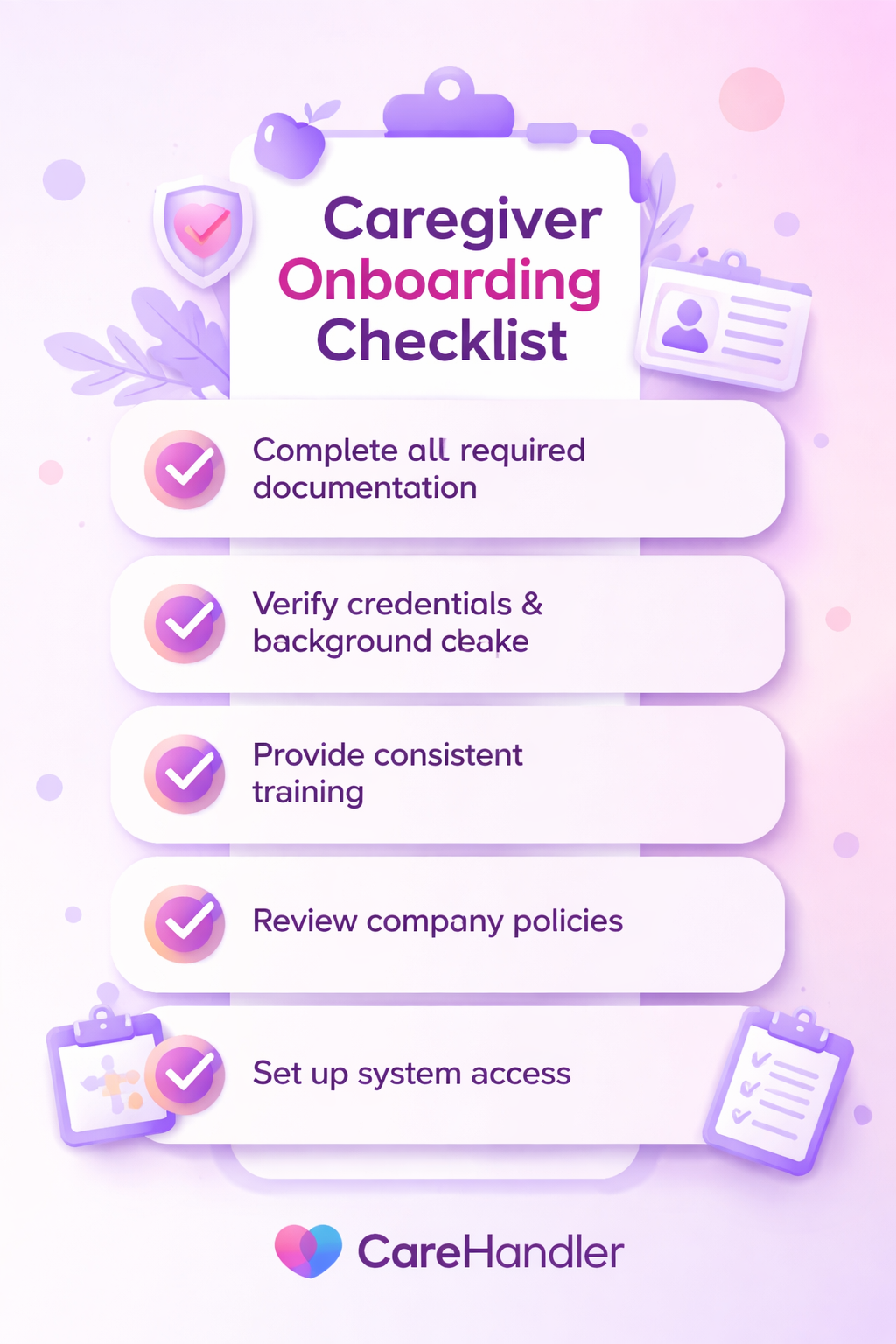
Using Standardized Caregiver Onboarding Checklists

Bringing on a new caregiver is more than just filling a position—it’s a critical moment that directly impacts your agency’s compliance, client safety, and overall quality of care.

Without a structured onboarding process, important steps can be missed. Documentation gets delayed. Training becomes inconsistent. And small gaps can quickly turn into major compliance risks.

That’s why creating a standardized caregiver onboarding checklist is one of the most effective ways to protect your agency and set your team up for success.


What Is a Caregiver Onboarding Checklist?

A caregiver onboarding checklist is a step-by-step process that ensures every new hire completes all required:

  • Documentation
  • Training
  • Credential verification
  • Compliance steps

Before they begin working with clients.

Instead of relying on memory or scattered processes, a checklist creates a repeatable, accountable system.


Why Standardization Matters

When onboarding is inconsistent, agencies often run into:

  • Missing or incomplete employee files
  • Expired or unverified credentials
  • Caregivers starting shifts before being fully cleared
  • Increased audit risk
  • Variability in care quality

Standardization eliminates these gaps.

Every caregiver goes through the same process, every time, ensuring nothing is overlooked.


Key Components of an Effective Onboarding Checklist

A strong onboarding checklist should cover four core areas:

1. Employment Documentation

Ensure all required paperwork is completed and stored properly:

  • I-9 verification
  • W-4 and state tax forms
  • Direct deposit setup
  • Signed policies and procedures

2. Credential Verification

Before a caregiver is scheduled, confirm:

  • Licenses or certifications (if required)
  • Background checks
  • TB tests or health screenings
  • Any state-specific compliance requirements

3. Training and Orientation

Every caregiver should receive consistent training, including:

  • Agency policies and expectations
  • EVV and documentation requirements
  • Client care standards
  • Safety protocols

4. System Access and Readiness

Before their first shift, ensure caregivers:

  • Have access to your systems
  • Understand how to clock in/out
  • Know how to complete visit notes
  • Can communicate with your administrative team

How This Impacts Compliance

From an audit perspective, onboarding is one of the first places reviewers look.

Incomplete files or missing documentation can lead to:

  • Compliance violations
  • Payment recoupments
  • Increased scrutiny from payers

A standardized checklist creates a clear paper trail, showing that:

  • Every caregiver was properly vetted
  • Required documentation was completed
  • Training was consistently delivered

This makes your agency audit-ready by design, not by last-minute preparation.


How This Improves Quality of Care

Beyond compliance, onboarding directly affects the care your clients receive.

When caregivers are:

  • Properly trained
  • Clear on expectations
  • Confident using your systems

They are far more likely to:

  • Deliver consistent, high-quality care
  • Complete accurate documentation
  • Communicate effectively with your team

Consistency at the start leads to consistency in the field.


Building Accountability Into Your Process

A checklist doesn’t just organize tasks—it creates accountability.

To make it effective:

  • Assign ownership for each step
  • Require sign-offs before moving forward
  • Prevent scheduling until onboarding is complete

This ensures that compliance is not optional—it’s built into your workflow.


How Carehandler Supports Structured Onboarding

At Carehandler, we believe that strong operations start with strong systems.

By connecting caregiver onboarding with scheduling, documentation, and billing workflows, agencies can:

  • Ensure caregivers are fully cleared before working
  • Maintain complete and accessible records
  • Reduce administrative errors
  • Strengthen compliance across the board

When onboarding is standardized, everything that follows becomes more consistent.


Final Thoughts

A caregiver onboarding checklist may seem simple, but its impact is significant.

It protects your agency.
It supports your caregivers.
And it ensures your clients receive the level of care they deserve.

Because in homecare, consistency isn’t just operational—it’s essential.

Categories
Tips & Tricks

A Simple Habit That Protects Your Home Care Agency

In the fast-paced world of home care, it’s easy for documentation to slip down the priority list—especially after a long shift. But one small habit can make a significant difference in your agency’s compliance, efficiency, and overall quality of care: encouraging caregivers to complete visit notes immediately after each shift.

The Risk of Delayed Documentation

Delayed documentation is one of the most common issues agencies face during audits and compliance reviews. When notes are completed hours—or even days—after a visit, important details can be forgotten, timelines become unclear, and inconsistencies may arise. Even if the care provided was excellent, poor documentation can create the appearance of gaps in service or non-compliance.

Auditors and regulators aren’t just reviewing care—they’re reviewing proof of care. If it’s not documented properly and promptly, it can raise red flags that put your agency at risk.

Why Immediate Documentation Matters

Encouraging caregivers to document right after their shift helps ensure:

  • Accuracy: Details are fresh, reducing the chance of errors or omissions.
  • Consistency: Notes reflect a clear, real-time record of care provided.
  • Accountability: Caregivers develop a reliable routine that supports compliance.

Timely documentation doesn’t just check a box—it tells the full story of the care your team delivers.

Protecting Your Agency, Caregivers, and Clients

Consistent documentation acts as a safeguard for everyone involved:

  • Your agency is protected during audits and compliance reviews.
  • Your caregivers have a clear record that supports their work and professionalism.
  • Your clients benefit from continuity of care, as accurate notes inform future visits and care plans.

In many cases, documentation can be the deciding factor in disputes, billing questions, or regulatory concerns. Having clear, timely notes ensures you’re always prepared.

Building Better Habits Across Your Team

The good news? This is a fixable issue. Small administrative habits can prevent major compliance problems. Consider:

  • Setting clear expectations for when notes must be completed
  • Using mobile-friendly documentation tools to make it easier in the field
  • Reinforcing the importance of timely notes during training and team meetings
  • Monitoring completion times and addressing delays early

When immediate documentation becomes part of your agency’s culture, it stops feeling like a burden and starts becoming second nature.


In home care, the smallest habits often have the biggest impact. Encouraging caregivers to complete visit notes right after each shift is a simple, practical step that strengthens compliance, improves care quality, and protects your entire operation.

Because at the end of the day, great care deserves to be clearly—and promptly—documented.

Categories
Tips & Tricks

The 3 Ways Agencies Usually Lose Money

When agencies talk about revenue loss, the conversation almost always starts with claim submission. Were claims submitted on time? Were they clean? Were they accepted? While submission accuracy is important, it is rarely where the biggest financial losses actually occur.

In reality, most agencies lose money after payments are posted. The most damaging revenue leaks are quiet, incremental, and often invisible without proper reconciliation and controls. Over time, these losses add up to significant missed revenue.

Here are the three most common ways agencies lose money —

1. Short Pays That Are Never Identified

Short pays occur when an insurance payer reimburses less than the expected amount for a claim. This can happen for many reasons, including incorrect rates, partial payments, bundled services, or payer processing errors. The issue is not that short pays happen — the issue is that they often go unnoticed.

When payments are posted without a clear comparison between what was billed and what was actually paid, short pays quietly disappear into remittance data. Without systematic reconciliation, staff may assume payment was correct simply because money was received. Over time, dozens or even hundreds of underpaid claims can accumulate without follow-up.

Without visibility into expected versus actual reimbursement, agencies lose revenue they were contractually owed.

2. Adjustments Hidden Inside Remittance Files

Adjustments are another major source of invisible revenue loss. Insurance remittance advice often includes adjustments that reduce payment amounts, sometimes bundled under codes or descriptions that are difficult to interpret quickly.

In many workflows, remits are posted in bulk. Adjustments are accepted automatically, without review, documentation, or approval. Once posted, these reductions blend into historical financial data and become difficult to track or reverse.

The problem is not that adjustments exist. The problem is that they are frequently applied without scrutiny. Without a system that surfaces adjustments clearly and requires review, agencies may accept reductions that should have been appealed, corrected, or questioned.

3. No Reconciliation Means Revenue Loss Is Invisible

The most dangerous revenue leak is the lack of reconciliation itself. When agencies do not reconcile claims, remittances, and payments at a detailed level, revenue loss becomes invisible.

Without reconciliation, there is no reliable way to answer critical questions such as whether a claim was paid in full, whether a rate was applied correctly, or whether an adjustment was valid. Financial reports may appear accurate on the surface, while underlying discrepancies remain unresolved.

This invisibility creates false confidence. Leadership believes revenue is being captured correctly, while money continues to slip through the cracks month after month.

Why Software Must Do More Than Post Payments

Modern agency software should not simply record payments. It should actively guide users through correction workflows. That includes flagging short pays, clearly surfacing adjustments, and identifying discrepancies between expected and received amounts.

Effective systems require approvals for changes, ensuring that financial adjustments are intentional and reviewed. They also document every change, creating an audit trail that supports compliance, appeals, and internal accountability.

When software enforces reconciliation, requires approval, and documents changes, revenue loss becomes visible — and correctable.

Making Revenue Protection a Process, Not a Guess

Protecting revenue is not about working harder or submitting more claims. It is about having systems and processes that make discrepancies impossible to ignore.

Agencies that reconcile payments, review adjustments, and use software designed to guide corrections are able to recover lost revenue, reduce risk, and gain confidence in their financial reporting.

Because the biggest financial losses are rarely dramatic. They are quiet, gradual, and hidden — until the right tools bring them to light.

Categories
Tips & Tricks

Helpful Tips & Tricks for Agency Owners!

Helpful Tips & Tricks for Home Care Agency Owners in Idaho

Just some friendly tips & tricks ????

Signed Information Release, indicates your organization has on file a signed statement by the Participant authorizing release of medical data to other organizations. This is for the automated billing feature. Your patients DO NOT have to accept this. The feature will still work even if you put it as informed, declined release.

You can send a secure message to Gainswell by clicking on the yellow envelope ✉ icon. You can include all denied claims in the message, but you most include the following items for them to view and process your message: Claim #, Pay to NPI, Pay to Name, Member Name, Member Date of Birth, Date of Service, and Total Bill Charges. Include your name, reason for messaging, and the error message you received from Gainswell. This will help you get straight answers on how to fix your claim and get it accepted.

Emails:
Phone Numbers: 208-373-1351 – 208-373-1424
Need the link to the Medicaid handbook? Click here

Make sure to check your Sandata visits in your Sandata dashboard for any error messages. Any error messages you don’t understand, email Sandata or email us the error.

Try to NOT date span when submitting claims. Date spanning can result in EVV and Claim data not matching. Data not matching = denial to your claim!

Some providers, for payroll purposes, are consistently rounding up to the next 15-minute unit. This principle does not apply to visit time. Sandata does not “round” any data that it consumes. Example: a visit clock in is 10:03AM and the clock out time is 10:50AM. Total visit time = 47 minutes. This means that only 3 15-minute units are billable, not 4 units. If the provider bills 4 units, the claim will deny for unit mismatch.

The claims’ engine does not apply “lesser of” billing logic for units mismatch: if provider’s billable hours are 27 units in Sandata, and provider bills 28 on the corresponding claim, currently the claim is denying for unit mismatch. It is critically important that providers’ billed units do not exceed the corresponding billable visit time.
Follow the link here to view all the EVV Idaho Medicaid resources.

Check your visits in Carehandler for any error messages and to ensure that all visits have been sent off successfully to Sandata for processing.

You can now go to the visit’s section of Carehandler, click on “Export Visits Rendered” and export all visit data that included the service code & the total number of units used for that visit! We hope this helps when you are submitting claims. All your data is now is one place 🙂

Caregivers filling out missing appointments will still count towards EVV. Make sure you have your caregivers fill out those shifts, then go into visits and make sure you make any administrative adjusts before hitting submit!

There cannot be any spaces or symbols in an employees or caregivers name! Sandata will reject the visit if they have any. Also, when entering a SSN, make sure to just add the last 5 digits and not any (-) or symbols!

When entering a participant’s address, if they live in an apartment complex, please make sure to put their apartment number in the address line. This will insure no errors come up when caregivers try and click on an address.

Make sure each employee has their SSN filled out so that Sandata can verify the visit. Make sure each profile has been ‘updated’.

The Caregiver will be able to clock in to the current appointment anytime BEFORE the shift end time. For example, if the shift is scheduled to start at 9am and end at 1pm, they have anytime from 9am to 12:59pm to clock into the shift and record their time. The shift stays open in case the caregiver is late by a force they cannot control, they need to start later for reasons given by the participant, or if by administration approval they are able to start later than the start time. Please instruct them that they will need to still work the scheduled hours, not necessarily the scheduled time.

If an employee or participant has an unapproved error from Sandata in their profile, sometimes all it takes is to hit the ‘update’ button in the top right of the participant/employee profile.
Any unknown Sandata error you receive, please forward it on to us by taking a screenshot and giving us a quick message as to what you were trying to accomplish before this error came up. We can help communicate with Sandata’s support team to get some answers for you 🙂

Pending status in visits means the caregiver needs to fill out the appointment in missed appointments. Make sure they give a reason why they missed it or attended the visit at another time OR if there were technical difficulties make sure they put that reason in there.

Make sure location tracking is turned on for the app by going to settings –> carehandler app –> Location –> Always allow or allow while using.

Sometimes on android it can help if your caregivers are not seeing things to clear their app data and cache. Here is a video on how to do that —> View Video

Don’t be afraid to troubleshoot the issue with your team. You can certainly ask us for help, but this helps us get to the bottom of the issue faster if these things are answered first.

Ask questions like this to help get to the bottom of an issue:
Is all the employee and patient information filled out?
Is this email being used with another agency? Does this Caregiver have multiple jobs with another agency using Carehandler?
Is the email correct and spelled correctly?
Did I have my caregiver take a video of what is happening? Did I take screenshots of the error messages and problems I am having?

Home Care Pulse has some great resources on their website to help Home Care agencies tackle the everyday challenges they face. Check them out when you get a chance!

Don’t forget that we are constantly making this app better for you and love getting feedback on the product! Thank you for all your support!

Thank you for Subscribing