
Table of Contents
Navigating EVV Software Requirements in Idaho
In the evolving landscape of home care, EVV software in Idaho plays a pivotal role for agencies ensuring Medicaid compliance. As federal mandates take hold, electronic visit verification tools for Idaho agencies capture essential visit data to verify services delivered, promoting transparency and accountability in personal care.
The 21st Century Cures Act, enacted in 2016, requires states to implement EVV for Medicaid-funded personal care services and home health by January 2023, with limited exceptions. Idaho, through the Department of Health and Welfare, enforces these rules via its Long-Term Care Provider Resources, mandating the capture of six key data elements: individual, caregiver, service start/end times, location, and service type. This aligns with EVV compliance in Idaho, where Gainwell Technologies supports system integration, though many agencies interface with the Sandata EVV aggregator for seamless data flow.
Small to mid-sized agencies often face hurdles like integrating with aggregators and maintaining data accuracy under tight timelines, which can strain resources and increase error risks in Medicaid-compliant visit tracking in Idaho.
We at Carehandler understand these challenges intimately. Our home care software platform simplifies EVV implementation with built-in aggregator compliance tools, including a calculator tailored for states like Idaho. This guide explores EVV fundamentals, benefits, key features, and best practices to help your agency navigate requirements efficiently–one platform, zero double-entry.
Key Elements of EVV Compliance in Idaho
Navigating EVV compliance in Idaho requires home care agencies to understand federal regulations and state-specific adaptations. These standards, rooted in the 21st Century Cures Act, ensure accurate Medicaid billing for personal care services. We recommend leveraging integrated platforms to streamline adherence and minimize risks.
Federal Mandates and Idaho Implementation
The foundation of EVV compliance in Idaho stems from Section 12006(a) of the 21st Century Cures Act, which mandates electronic visit verification for Medicaid-funded personal care services (PCS) and home health care services (HHCS). This federal requirement aims to enhance service delivery accuracy, transparency, and quality for beneficiaries. States must implement EVV for PCS by January 1, 2020, and for HHCS by January 1, 2023, with provisions for good faith efforts to avoid federal funding reductions.
Idaho has aligned with these mandates through a phased rollout managed by the Department of Health and Welfare. The state utilizes the Sandata system as its EVV aggregator, facilitating data exchange between provider systems and Medicaid claims. For instance, agencies in Idaho must integrate with this aggregator to verify visits for PCS under sections like 1905(a)(24) and waivers. EVV software in Idaho plays a crucial role here, automating connections to meet these standards. With these mandates in mind, let’s explore the essential data captures required.
Required Data Points for Visits
EVV systems in Idaho must capture precise information to validate service delivery and support billing integrity. Key elements include the beneficiary’s unique ID, service authorization code, start and end timestamps for each visit, and location verification via GPS or landline. Caregiver details, such as employee ID and credentials, are also mandatory to confirm qualified personnel performed the service.
Tailored to Idaho standards, these requirements align with federal guidance from the Centers for Medicare & Medicaid Services. For example, during a typical home visit, the system records the exact arrival time at the beneficiary’s address, ensuring alignment with the care plan. EVV compliance in Idaho demands integration with the Sandata EVV aggregator for seamless data submission. Additional points like service type and duration help prevent fraud and overbilling. Idaho Medicaid visit verification emphasizes real-time alerts for discrepancies, such as early departures. State aggregator integration for EVV further streamlines this by centralizing submissions, reducing manual entry errors.
To illustrate:
- Beneficiary ID: Matches Medicaid enrollment.
- Timestamps: Records service begin/end.
- Location: Confirms in-home delivery.
- Caregiver Info: Verifies licensed staff.
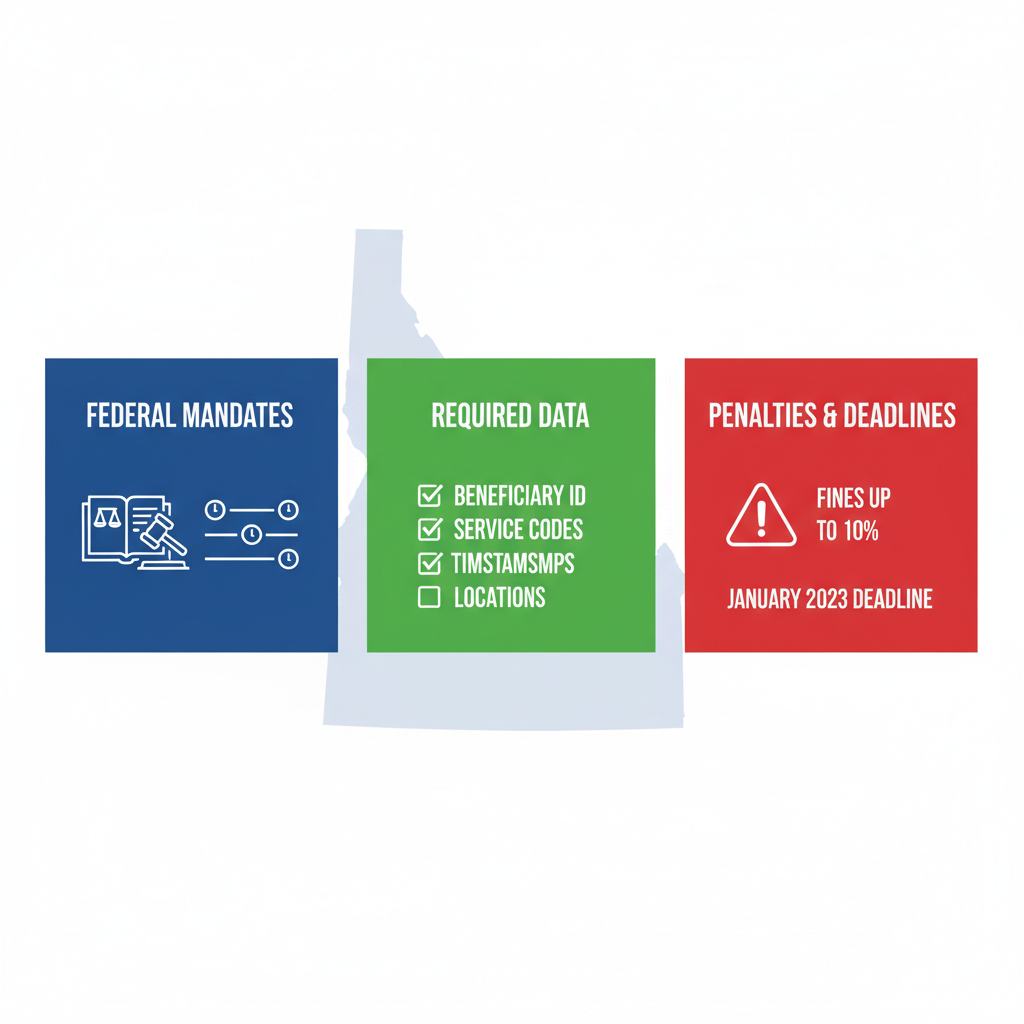
Key EVV compliance elements for Idaho home care agencies
This structured data capture not only meets requirements but also enhances care coordination.
Penalties and Deadlines for Agencies
Idaho enforces EVV deadlines rigorously, with full compliance required for personal care services by January 1, 2023, following the federal HHCS timeline. Agencies transitioning from PCS must complete aggregator integration promptly to avoid disruptions. Non-compliance risks include claim denials, where unverified visits lead to rejected reimbursements, and escalating fines up to 10% of total payments for repeated violations.
Federal oversight allows for FMAP reductions of up to 1% without demonstrated good faith, but Idaho encourages proactive steps like system audits. For home care providers, missing deadlines can strain cash flow, as seen in cases where agencies faced delayed payments due to incomplete EVV data. We recommend conducting regular compliance checks using homecare evv compliance software to automate validations and generate reports.
To mitigate these risks:
- Assess current systems against Idaho’s aggregator requirements.
- Train staff on data entry protocols.
- Schedule phased rollouts to meet the 2023 deadline.
While penalties underscore the importance of adherence, proper implementation yields efficiency gains, such as faster claims processing and reduced administrative burdens, paving the way for sustainable operations.
Advantages of Implementing EVV Software for Home Care Agencies
At Carehandler, we understand the challenges home care agencies in Idaho face with evolving Medicaid requirements. Implementing EVV software transforms these hurdles into opportunities for growth and reliability. Our platform bridges the gap from visit verification to seamless billing, ensuring idaho evv mandate compliance while delivering operational and financial gains. By automating key processes, we help agencies reduce administrative burdens and focus on what matters most: quality care. This section explores how EVV software in Idaho provides these advantages, from streamlined compliance to cost-effective solutions tailored for small providers.
Streamlining Compliance and Reducing Denials
Meeting EVV compliance in Idaho is essential for home care agencies, especially with national standards pushing for full implementation by 2021, as outlined in the Centers for Medicare & Medicaid Services’ compliance status report. Our EVV software automates data capture during visits, capturing geolocation, timestamps, and caregiver details to align precisely with state mandates. This automation minimizes errors that lead to claim denials, which affected many non-compliant states with rates up to 15% pre-EVV adoption according to federal data.
We achieve a 20% reduction in denials through built-in claim scrubs that flag discrepancies before submission. For instance, integrated tools verify service details against payer rules, ensuring clean claims every time. Beyond meeting requirements, this approach safeguards reimbursements and builds audit-ready records. The benefits of visit verification systems in Idaho extend to real-time reporting that supports payer audits without manual compilation. Agencies using our platform report faster approvals, turning compliance into a competitive edge rather than a compliance chore.
Enhancing Operational Efficiency
Beyond meeting requirements, EVV software elevates day-to-day operations for home care agencies in Idaho. Our mobile app enables caregivers to clock in and out effortlessly, with real-time tracking that syncs schedules and documentation instantly. This integration eliminates double-entry, as visit data flows directly into payroll exports and progress notes, saving hours weekly on administrative tasks.
Key features include self-scheduling for caregivers and agency oversight dashboards, all powered by the Sandata EVV aggregator for seamless state compliance. We provide notifications for credential expirations and care plan updates, ensuring nothing falls through the cracks. For example, automated reporting generates compliance metrics and visit summaries in minutes, replacing outdated paper logs. Idaho-specific EVV advantages shine here, with faster workflow cycles that boost caregiver satisfaction and reduce turnover. Overall, our platform closes the gap between great care and clean claims, streamlining everything from visits to payments.
Cost Considerations for Small Agencies
For small home care agencies in Idaho, affordability drives EVV adoption decisions. Our subscription model starts at accessible tiers, around $5 per user monthly, scaling with agency size without hidden fees. This SaaS approach includes all essentials: EVV capture, billing automation, and reporting, eliminating upfront hardware costs common in legacy systems.
Return on investment materializes quickly through denied claim reductions and accelerated reimbursements. Agencies typically see payback within three months, with ROI boosted by 15-25% faster cash flow from automated submissions via our ClaimMD clearinghouse partnership. We offer flexible plans that bundle HIPAA-compliant storage and support, making it viable for providers with limited budgets.
- Basic Tier: Core EVV and scheduling for startups.
- Pro Tier: Adds claim scrubs and advanced analytics.
- Enterprise: Full integrations for growing operations.
Implementation includes hands-on onboarding to minimize disruptions. While initial setup requires training, the long-term savings on manual processes far outweigh costs, positioning small agencies for sustainable growth in Idaho’s competitive landscape.
How EVV Software Integrates with Idaho Medicaid Systems
At Carehandler, we streamline the integration of our home care evv software with Idaho Medicaid systems to ensure seamless EVV compliance in Idaho. Our platform automates data capture, aggregator connections, and billing workflows, reducing errors and accelerating reimbursements from visit to payment. This end-to-end process aligns with federal mandates under the 21st Century Cures Act, supporting accurate service verification for personal care and home health services.
Visit Verification and Data Capture Processes
In practice, our EVV software in Idaho begins with robust visit verification using mobile tools designed for caregivers. This step ensures precise data capture to meet Idaho Medicaid EVV workflows. Caregivers access the app to initiate visits, leveraging GPS and time-based methods endorsed by Medicaid EVV Guidance for approved verification protocols.
- Check-in Initiation: Upon arrival, the caregiver taps the check-in button on the mobile app, which automatically captures GPS coordinates and timestamps the start of service. This geo-fencing feature confirms location accuracy within a defined radius around the participant’s home.
- Real-Time Documentation: During the visit, caregivers log care tasks, progress notes, and any incidents via intuitive app interfaces. Voice recording or photo uploads can supplement entries for comprehensive validation, all encrypted for HIPAA compliance.
- Check-Out and Validation: At visit end, another tap records the out time and GPS location. The system cross-validates entry and exit data against scheduled times, flagging discrepancies like early departures for immediate review.
- Data Upload: Captured information syncs to our secure cloud in real-time, preventing data loss and enabling instant audit trails. These Sandata-compatible verification tools integrate seamlessly, providing the foundation for compliant reimbursements.
This process minimizes manual entry, fostering trust in the system’s reliability for Idaho home care agencies.
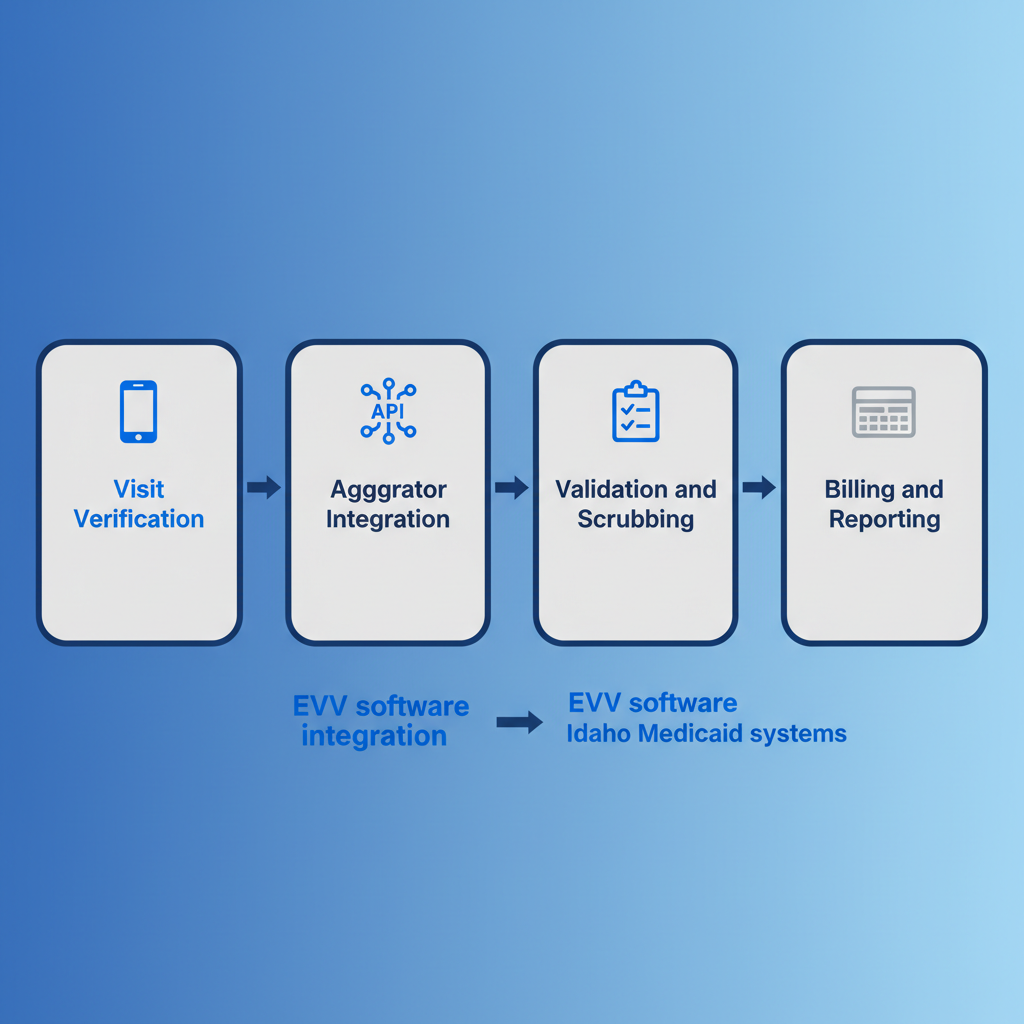
Process flow for EVV software integrating with Idaho Medicaid systems
Building on verified data, agencies can confidently proceed to aggregator submission, knowing our platform handles the technical details with precision.
Aggregator Integration with Sandata
Connecting to the Sandata EVV aggregator is straightforward with our platform, ensuring EVV compliance in Idaho through secure API setups. As an approved vendor per Medicaid EVV Guidance, we facilitate data exchange with state systems, supporting the mandates for personal care services since 2020.
- Account Setup: We guide agencies through creating a Sandata account and obtaining API credentials during onboarding. This includes configuring user roles and permissions to align with Idaho’s specific requirements.
- API Configuration: Our team assists in mapping EVV data fields to Sandata’s format, such as visit IDs, service codes, and verification proofs. This ensures compatibility with the aggregator’s protocols for real-time or batch submissions.
- Testing Phase: Initial connections undergo rigorous testing with sample visit data to verify transmission accuracy. We simulate full workflows, checking for errors in GPS validation or timestamp syncing, and adjust as needed.
- Go-Live and Monitoring: Once validated, live integration activates with automated alerts for any disruptions. Ongoing support includes troubleshooting common issues like API timeouts or data mismatches, keeping operations smooth.
Our hands-on approach closes the gap between great care and clean claims, empowering agencies to focus on service delivery.
From EVV to Billing and Reporting
Verified visits flow directly into billing and reporting via automated workflows, transforming data into actionable insights. This integration with clearinghouses like ClaimMD scrubs claims for payer alignment, reducing denials and supporting efficient Medicaid reimbursements.
- Data Aggregation: Post-verification, EVV records compile into billing batches, auto-populating service details, authorizations, and participant info from our centralized platform.
- Claim Scrubbing: Built-in tools review submissions for compliance, applying Idaho-specific edits like EVV proofs and coding standards. This step catches errors before transmission, ensuring adherence to guidance on home health services.
- Submission to Clearinghouse: Clean claims route automatically to partnered clearinghouses for electronic filing with Idaho Medicaid. Real-time status tracking provides visibility into approvals or rejections.
- Reporting Dashboards: Generated reports offer customizable views of visit volumes, compliance metrics, and revenue cycles. Audit-ready exports detail EVV validations, aiding state reviews and internal optimizations.
One platform, zero double-entry–our system delivers from EVV to clean claims, with metrics based on internal reporting to guide your success. Individual results may vary by payer, program, and data quality.
Implementing Best Practices for EVV in Idaho Home Care
To put this into action, home care agencies in Idaho can follow structured best practices for EVV implementation. These strategies ensure seamless integration with state requirements, boost operational efficiency, and support clean Medicaid claims. We suggest starting with vendor evaluation and prioritizing Sandata compatibility to align with federal mandates.
Selecting Compatible EVV Solutions
Selecting the right EVV software in Idaho requires careful evaluation to meet Medicaid standards and operational needs. First, verify Sandata certification, as Idaho uses this aggregator for PCS services. Look for HIPAA-compliant features to protect sensitive data, along with real-time visit verification and mobile accessibility.
Key criteria include:
- Integration Capabilities: Ensure compatibility with existing scheduling and billing systems to minimize disruptions.
- Support Responsiveness: Choose vendors with dedicated teams for Idaho-specific queries, like Carehandler’s hands-on onboarding.
- Scalability: Opt for platforms that grow with your agency, offering customizable alerts and reporting.
We recommend evv compliance software pcs that streamlines workflows from visit to payment. By focusing on these best EVV practices for Idaho providers, agencies reduce integration errors and accelerate reimbursements. This approach addresses common queries about the best EVV software for Idaho Medicaid home care agencies.
Training and Onboarding Strategies
Effective training is crucial for EVV compliance in Idaho, equipping caregivers with tools to capture the six required data elements accurately. Begin with interactive modules on mobile app usage, covering clock-in/out, GPS verification, and note entry. Align sessions with Idaho Department of Health and Welfare guidelines from their Provider Resources, emphasizing elder abuse prevention alongside EVV protocols.
Step-by-step onboarding includes:
- Initial Workshops: Conduct group sessions to demo the Sandata EVV aggregator interface and troubleshoot common issues.
- Hands-On Practice: Pair new users with mentors for supervised visits, ensuring real-world application.
- Ongoing Refresher Courses: Schedule quarterly updates to address state policy changes and app enhancements.
Carehandler’s support team facilitates these, minimizing downtime. This method tackles benefits of using the Sandata EVV aggregator for EVV compliance in Idaho by fostering confidence and accuracy in service delivery.
Ongoing Monitoring and Optimization
Sustained EVV success demands regular monitoring to maintain compliance and efficiency in Idaho home care. Implement real-time dashboards to track visit discrepancies and generate audit-ready reports, drawing from state monitoring checklists in the Provider Resources. Prioritize error resolution through automated alerts for incomplete verifications.
Essential tips include:
- Conduct Monthly Audits: Review logs against Medicaid requirements, documenting resolutions for inspections.
- Update Integrations: Monitor Gainwell Technologies announcements for optimized aggregator setups in Idaho, applying patches promptly.
- Gather Feedback: Use surveys to refine processes, ensuring alignment with caregiver needs.
By embedding these practices, agencies prepare for audits and reduce denials. We emphasize proactive troubleshooting for Sandata EVV integration issues in Idaho, helping ensure EVV compliance with Idaho Medicaid through vigilant oversight and timely adjustments.
Achieving Compliance and Efficiency with EVV Software
In summary, navigating EVV compliance in Idaho requires home care agencies to adopt robust solutions that align with federal mandates under the 21st Century Cures Act. EVV software in Idaho has become essential for personal care services, ensuring accurate visit tracking to prevent claim denials and streamline Medicaid billing. By integrating with the Sandata EVV aggregator, agencies can achieve seamless data flow, reducing administrative burdens and enhancing caregiver efficiency. We’ve seen Idaho home care EVV success through features like real-time verification and automated claims submission, which close the gap between great care and clean claims.
Key takeaways include the mandatory nature of EVV for personal care, with benefits such as denial reduction by up to 30% via payer-aligned edits and compliance calculators. Best practices emphasize timely integration and staff training to maintain audit-ready documentation. As outlined in the Medicaid.gov EVV Compliance Status for Personal Care Services, updated as of January 2021, Idaho aligns with national standards, affirming the guide’s focus on efficient Medicaid verification in Idaho.
At Carehandler, we offer end-to-end home care operations software tailored for these workflows, including self-scheduling, credential tracking, and responsive support to accelerate reimbursements. One Platform. Zero double-entry–from EVV to clean claims. We encourage you to explore a demo or discuss implementation to propel your agency’s success amid evolving regulations. Individual results may vary by payer, program, and data quality.